Comments or questions? Bernhard Roetzel replies.
Diesen Beitrag gibt es auch auf Deutsch. Auf Deutsch lesen →
Why are suit alterations necessary?
Ready-to-wear was invented so that you could take the suit home with you the moment you bought it. But who can actually do that? Some suit alterations are almost always needed, if only to bring the trouser legs to the right length.
In most cases more than that would be needed. Many salespeople, though, do not point out to their customers what would have to be done, or could be done. They are glad if the customer buys and takes the suit away. Untrained staff often do not even recognise the faults in the fit.
At a long-established outfitter like Brummer in Berlin it is company policy to let customers go home only with a garment that fits as well as it can. And even to advise against the purchase if an alteration would not be possible and no alternative, bespoke aside, is available.


Once standard: the alterations workshop in house
Department stores and larger outfitters used to run their own alteration workrooms. That way the alterations could be pinned either by the salesman or straight away by the tailor. Today an in-house alterations atelier is the exception. Brummer in Berlin still offers the service, not least because it then has full control over the quality of the work.

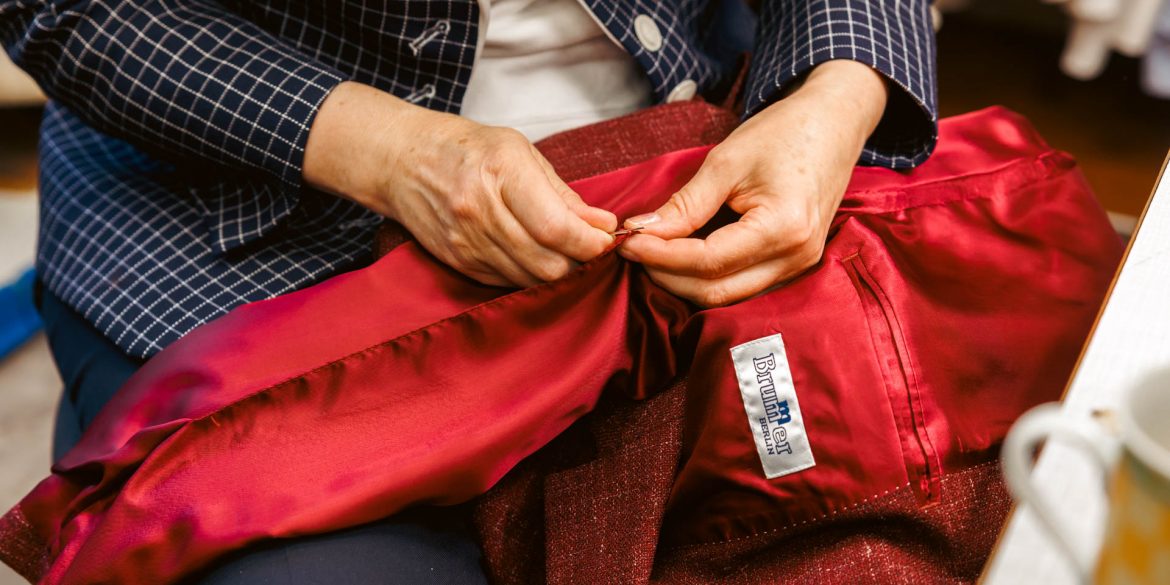
The workshop lies immediately to the right in the shop, in open view from the sales floor. Several tailors are employed there to alter the ready-to-wear that has been sold, or to refine the fit of bespoke orders. They are trained tailors, some with decades of experience behind them.
How the fit is improved
To judge which alteration is needed you have to know the goal: the right fit. So we explain it for each part of the suit. We go in the order in which I try a suit on. For a first impression I put the jacket on. Only if I like it do I try the trousers as well. A suit should always be judged as a whole.
First: how do the trousers sit?
If I want the suit, I check the fit of the trousers first. I find it sensible to have them pinned first and to put the jacket on after that. I can judge the overall picture better when the length of the legs and the waistband have already been pinned.
The waistband that fits perfectly
At the waist the trousers should sit so that they do not slip without a belt. But not so tightly that they constrict. Trousers should not have to be altered by more than one size, otherwise the position of the pockets is no longer right.
The fit of the trouser leg at the back
Many customers have the trousers altered below the seat so that they follow the contour of the leg more closely at the back of the calf. Younger men in particular often dislike it when the trousers fall straight down from the seat.
I prefer the trousers to hang straight and not to follow the contour of the seat and the leg. I also like the greater freedom of movement. When making the alteration the tailors have to take care that the trousers do not sit too close to the seat. We had the alteration pinned for the photograph.


Leg width and bottom width
The overall width of the trouser leg matters a great deal for the impression the suit makes, yet very few people know that it can be corrected without difficulty. Alterations are measured at the hem, which is why work on the leg width is usually discussed in terms of the bottom width.
On a narrow, flat-front trouser in a size 50 the bottom width is around 20 cm, on a pleated trouser around 22 to 25 cm. Tailors put the tape all the way round the leg, so they quote the bottom width as double that figure. Short and stocky men do better to avoid very wide trousers, which compress the figure.


Trouser length and turn-ups
The bottom width is best altered together with the overall length. Good trousers are not yet hemmed when they go on sale, so that the length can be matched exactly to the customer.
Anyone unsure whether the suit looks better with or without turn-ups should order it with turn-ups first. They can always be taken off later. If the decision has gone the other way, towards a plain hem, the inlay, meaning the cloth folded up on the inside, is often not enough to conjure turn-ups out of.
The heel tape on the inside of the hem is dispensable. Versions in synthetic weave can even scratch the shoe. Some manufacturers supply the matching heel tape with suits that are sold with unhemmed legs. I have seen that at Brummer with a suit by Scabal, where the colour-matched tape was tucked into the trouser pocket.
A question of style: the perfect trouser length
The trouser length depends on the cut. Wider models are worn longer, narrow ones shorter. Wider trousers should break once, lightly, on the instep. At the back the hem finishes somewhere between the middle of the heel counter and the top of the heel.


Some salespeople advise that the trousers should reach the middle of the heel. By today’s standards that is often too long. The rule dates from a time of much wider legs. Narrow trousers are worn shorter. They rest very slightly on the shoe at the front, and at the back they extend past the top of the shoe or reach the middle of the heel counter. It often helps to have the hem sloped, making the leg shorter at the front than at the back.
Jacket alterations: what is possible
Alterations to the jacket are only worth doing if the overall length is right. It is correct when the seat is covered and the fastening button sits on or a little above the navel. By the golden section that is the optical middle of the body. The position of the pockets and buttonholes is set in relation to the overall length, so if the length were changed the pockets and buttons would sit too high or too low.

The areas that matter most: collar, back and shoulders
The fit at the collar, the back and the shoulders is checked first. The collar should lie close against the neck. If it does not, better to put a different suit on the shortlist. Alterations at the collar are relatively complicated. A fold at the nape, on the other hand, is easily dealt with.
What is meant is that the cloth below the collar pushes up horizontally and forms a fold across the back. Over the back the cloth has to lie flat, and behind the arms a small reserve of cloth should be visible. Without it the wearer could not move his arms forward, which is why it is called the movement fold.
Not too loose, not too tight: the right waist
To see whether the jacket has the right width at the waist, it is buttoned. Then the button is pulled gently. If the jacket swings forward by two to three centimetres, the waist is right. If there is more play than that, it is too loose. To change it, cloth is taken out at the side seams.
If you reduce the waist by taking cloth out at the centre back, the distance between the side vents becomes too small. Checks or stripes sometimes then run together unattractively at the centre. Better, therefore, to work at the side seams.
The waist is also a question of style and of how the jacket feels to wear. Personally I go by whether I can button it effortlessly and still notice that it is buttoned. Many men confuse a tailored fit with extreme tightness at the waist. If the jacket strains over the stomach and the side vents gape, it really is a little too tight.


Very important for the overall impression: the sleeve length
The right sleeve length is essential to the impression the jacket makes. If the sleeves end at the knuckles the whole jacket looks too big. If they are too short it looks too small. The length is correct when the shirt shows, by half a centimetre to several centimetres depending on taste and height. On an ordinary off-the-peg suit, shortening or lengthening the sleeves is very simple.


The alteration tailor removes the buttons at the cuff, shortens or lengthens the sleeve, and sews them on again in the new position. On suits with working cuffs that is of course not possible, because the buttonholes cannot be moved. That is why the buttonholes on the sleeve should only be cut open on jackets made to measure.


Alterations at the armhole: invisible from outside but not to the wearer
Alterations to the sleeve include the armhole. It is the one correction nobody sees but you feel very clearly. It becomes necessary when the jacket pinches under the arms but fits perfectly in every other respect, so that reaching for another model or another size is out of the question.
Anticipating alterations by ordering made to measure
Anyone ordering clothes made to measure at Brummer avoids the larger alterations, naturally. Even so, with individual orders it is sometimes necessary to work on the detail of a garment after the final fitting. Mostly, though, made-to-measure orders only go into the workshop when repairs are due. Or when the customer’s weight changes.


