Comments or questions? Bernhard Roetzel replies.
Diesen Beitrag gibt es auch auf Deutsch. Auf Deutsch lesen →
The bespoke tailoring houses of this world are unanimous that fittings are indispensable. Even with a proven pattern, no tailor would voluntarily give up seeing the half-finished suit on the customer twice. Only quite exceptionally, when a customer for whom suits have already been made several times really only has time for one fitting, or there is time pressure for other reasons, are the usual two fittings combined into one. That fitting then corresponds roughly to what would otherwise be the second, at which the pockets are already finished, for instance. Some Savile Row tailors who do a lot of business abroad also do without the second fitting and send the garment to the customer after one. Travelling tailors from Italy like to leave the second one out as well, to save costs. That is not the normal case, though, and customers should prick up their ears when tailors claim that from the second order onwards they can manage with one fitting.
Fittings, or made-to-measure
The fittings are an important thing that separates bespoke tailoring by a craftsman from made-to-measure. Some made-to-measure firms do offer fittings, but the garment is then far further advanced and can no longer be changed as fundamentally as the basted piece at a tailor’s first fitting. Quite apart from the fact that made-to-measure suits are always based on existing ready-to-wear patterns, so the position of the pockets or the width of the lapels cannot be altered at will. The French call the craft work “le grand sur-mesure” and made-to-measure “le sur-mesure industriel”, which describes the difference well. On one side the great craft work, called Vollmaß in German, on the other industrially produced made-to-measure clothing, which may nonetheless contain a high proportion of hand work. As clearly as the fittings separate the tailor’s work from the made-to-measure supplier’s, tailors are just as divided about how the first fitting should go. The point at issue is the sleeves. Should they be basted in at the first fitting or not? Some are for it, others against, and a third faction prefers to baste in only one of the two. Quite apart from certain Paris tailors, who for the first fitting cut and baste not the cloth the customer ordered but a neutral linen.
The English school: with both sleeves
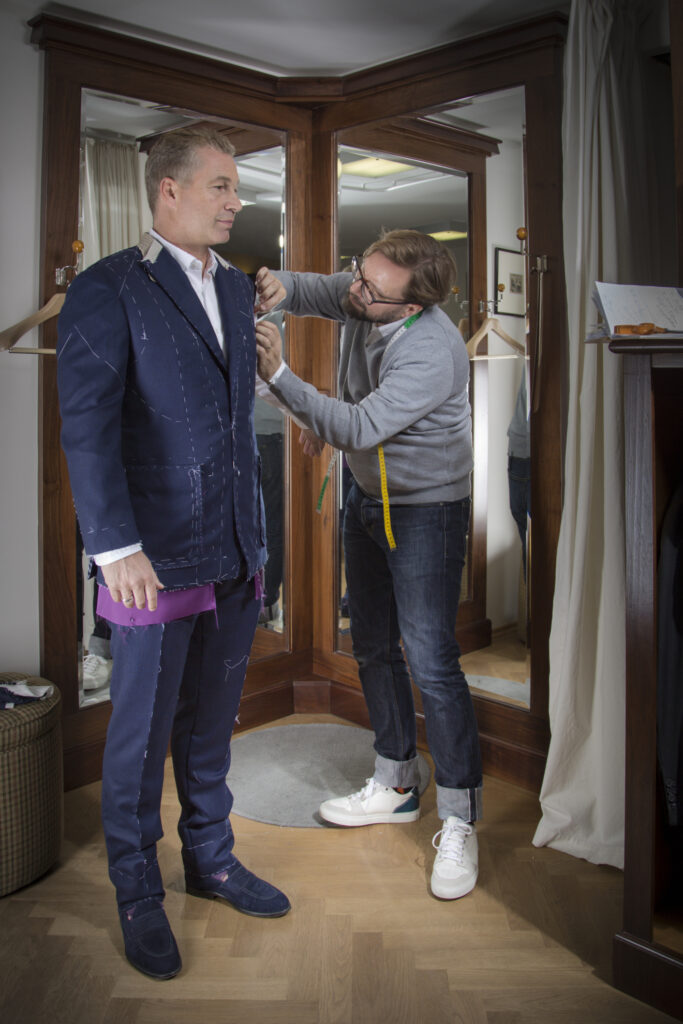
Consider first the methods of the English bespoke tailors. Here the fitting is as a rule done with both sleeves in, partly because the customer can form a better impression of his garment that way, and partly because the jacket has to be taken completely apart again after the first fitting anyway. Necessary alterations, such as enlarging the armhole, the tailor marks in chalk and carries out later. The third argument for fitting with sleeves is the time it saves. If something is wrong with the width or the position of the sleeve, it will show now and not at the second fitting. The altered sleeve can then be assessed at the second fitting along with everything else. Asked why his continental colleagues fit without sleeves, or with only one, a London cutter answered drily: “Perhaps they are too lazy to put the sleeves in for the fitting.”
The German answer: without sleeves
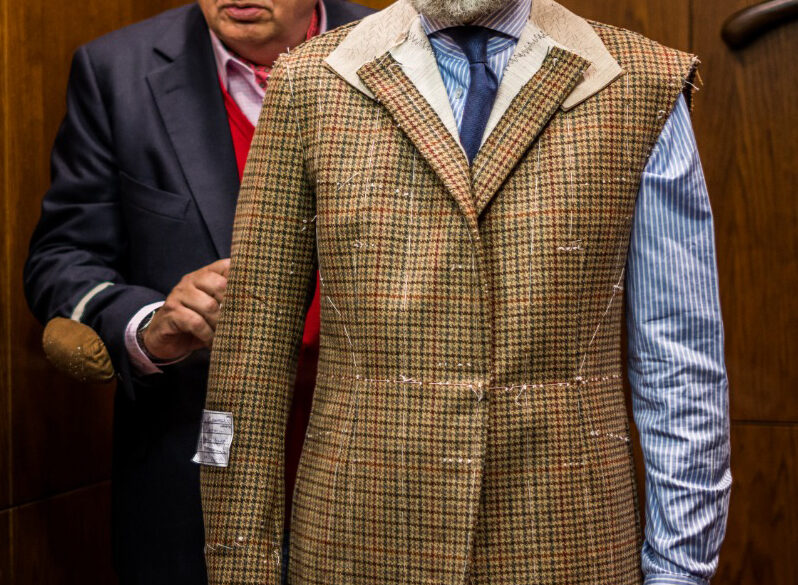
The colleagues so suspected reject the charge, naturally. One German bespoke tailor argues: “There is no point putting the sleeves in, since I may still have to do something at the armhole. And I can check the balance without sleeves too.” That may well be right, but the customer loses out in this procedure. Tailors who work without sleeves at the first fitting probably take the view that this important appointment is above all for them. The customer is brought in at the second stage, which is why the sleeves only go in then. Newcomers to a tailoring house in particular, though, are appalled at the first fitting by the sight of the sleeveless shell and can hardly imagine that an elegant garment will one day come of it. The small extra work of basting the sleeves in is therefore also a way of building trust, and it pays off precisely with first-time customers.
Why one sleeve alone is no solution
What then speaks for basting in one sleeve rather than both? This method has its followers too, but there is hardly a sound argument to be found for it. Either you leave the sleeves off altogether, for the reasons given, or you baste both in. It is true that a single sleeve shows whether its width is right, but whether it is set in correctly has to be checked on both sides. Which is why the trade paper Die Zuschneidekunst, published in Hanover in the 1930s, holds that either no sleeve or both are to be basted in. Besides which, the paper warns, there is a danger that with only one sleeve the garment pulls over to that side. The English bespoke tailor Simon Skottowe, who runs an atelier in Budapest, makes a compromise. He bastes both sleeves in for the first fitting and then checks how they sit and whether they still need to be turned. Turning the sleeve means adapting it to the way the arms hang when relaxed. Skottowe, who is a regular guest at the Viennese cloth merchant and outfitter Wilh. Jungmann & Neffe, also checks the fit of the sleeve at the biceps and at the shoulders. Then he takes the sleeves off again and checks the position of the armhole.
The Paris exception: the toile fitting
As mentioned above, some Paris tailors take a quite different route. They transfer the paper pattern not straight onto the cloth the customer wants but onto a neutral linen, the toile, which they then cut and baste. A method by which, incidentally, haute couture tailors also work when developing a model, as do some shirtmakers. What speaks for the technique is that with customers of very difficult figure the pattern can be changed drastically after the fitting, without disturbing the run of the pattern in the original cloth or even cutting into it wrongly. The toile of course hangs somewhat differently from the suiting, so later adjustments are necessary with this method too. Fitting a prototype in a neutral cloth certainly gives the cutter valuable insight, but not every customer is willing to wait longer for his suit because of it. Beyond that, the extra step raises the cost. Many women’s tailors here work with a toile, but men’s tailors use the method occasionally as well, Carlo Jösch in Cologne for instance.
Pins or chalk
The so-called pin fitting is part of how German bespoke tailors work. The basted garment is opened up directly on the customer and pinned together again. The future owner of the suit first puts the prepared jacket on. Using the cross marks made by tailor’s tacks, the cutter closes the forepart with pins. Sleeve length and shoulder width are then checked. Next the cutter removes the sleeves and the top collar, either unpicking the basting with scissors or tearing the pieces off with a flourish, depending on his personal style. Now he sets about checking the balance and improving it where necessary. For that the shoulder seam is opened and the forepart adapted to the contour of the body until the desired result is reached. The canvas in the shoulder is optimised as well. The back is then stroked up on the body and surplus cloth pinned out. When the shoulder is done, the cutter looks over the back and the sides once more, to open and re-pin them too if need be. Once that is done, the collar is fixed again. Heinz-Josef Radermacher in Düsseldorf works this way, or Volkmar Arnulf in Potsdam.
Opinions differ on whether the pin fitting makes sense or is rather superfluous, though it would be unfair to accuse its adherents of showmanship or even of a lack of confidence in cutting. Just as untrue is the idea that only the pin fitting guarantees a perfect result, since that claim would imply that the champions of the chalk fitting deliver less perfect suits. Pins and chalk should be seen as two different routes to the same goal. In general an experienced and talented cutter will in any case present a fairly well-fitting garment at the first fitting. Only with very difficult figures, or after large changes in weight, can it be justified to open a jacket on the body and pin it together again. Either way the customer should respect the working methods of the different tailoring traditions. Which approach appeals to him most depends in the end on which of those traditions he feels stylistically most at home in.
Photography (cover): Veronika Hanušová

